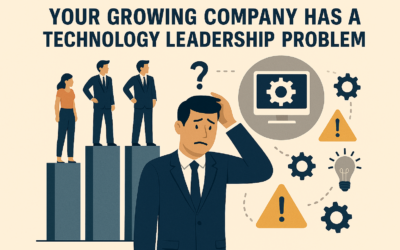

You know that awkward middle stage your company hits, I call it the ‘awkward teen phase’? You’re too big to keep running on whatever mishmash of technology got you here, but you’re not quite large enough to justify a full IT department with a CIO making six figures. So, you do what most companies do, you call a Managed Service Provider.
Don’t get me wrong, the MSPs can be experts. They know technology inside and out. They promise to handle everything. For many companies, it works well.
But there’s something worth thinking about: when the person telling you what technology you need is the same person who profits from selling it to you, how do you know you’re getting unbiased advice?
The Uncomfortable Truth About MSP Conflicts
Most MSPs are staffed with genuinely talented people who care about their clients. The challenge isn’t the people, it’s the business model itself, which creates conflicts that exist regardless of anyone’s intentions.
Think about buying a house. You wouldn’t want the seller’s agent to also be your advisor on whether it’s a good purchase, right? Yet that’s essentially what happens with technology decisions when your MSP is both recommending and implementing solutions.
Here’s how it works in practice:
Your MSP is having a conversation about your technology needs. At the same time, they’re running a business. More complex solutions mean bigger implementation projects. More systems to manage mean higher monthly retainers. Clients who are deeply integrated with systems only that MSP can manage? That’s stable, long-term revenue.
None of this makes every recommendation wrong. But there’s always another consideration in the room besides “what’s best for this client?”
Vendor partnerships add another layer. Many MSPs have “preferred vendor” relationships with rebates or special pricing that improves their margins. When evaluating solutions, those relationships naturally influence recommendations—maybe not in a malicious way, but they’re there, affecting the decision.
Even when an MSP is genuinely trying to give objective advice, they’re limited by what they know. They’ve invested in specific platforms. Their team is certified in certain systems. Those are the solutions they tend to recommend, whether or not they’re the perfect fit for your particular situation.
What This Actually Costs You
For medium-sized companies, these conflicts aren’t just theoretical—they have real consequences.
You end up with technology that’s more complex than you need. Companies regularly find themselves paying much more than they should for systems that could be replaced with simple cloud services. The reason? Their MSP built them something beautiful and intricate and completely over-engineered—a solution that requires constant management from, you guessed it, that same MSP.
You miss out on better options. There are tens of thousands of business software solutions out there. Your MSP probably works with a couple dozen of them. The odds that the perfect solution for your business happens to fall within that narrow slice aren’t great.
Your technology strategy ends up being about what your provider can deliver instead of what your business actually needs. How many times have you heard: “Well, our MSP says they can’t support that platform, so we’ll go with their recommendation instead”?
That’s the wrong way around. Your technology should support your business strategy, not the other way around.
There’s a Better Way
Technology Advisory Professionals works differently.
Our model starts with your business imperatives; what you’re actually trying to accomplish. We translate those into technology implications, then create clear technology imperatives that guide your decisions. From there, we help you act on those imperatives: building roadmaps, mentoring leaders, selecting vendors, making sure your providers deliver what you actually need.
We don’t implement anything. We don’t manage systems. We don’t have vendor partnerships or kickbacks. Our job is to give you unbiased strategic guidance, period.
Sometimes the best solution is sophisticated. Sometimes it’s simple. Sometimes it’s holding off and saving your resources for something more important. We’ll tell you what we honestly think because we don’t have any incentive to push you in one direction or another.
Companies work with this model because they want someone whose only stake is giving good advice—not in what gets implemented or who implements it.
Why This Matters for Your Company
Medium-sized companies face a particular challenge with technology decisions. The investments are significant, mistakes are costly. But you might not have the internal expertise to navigate all this complexity with confidence.
The decisions you make at this stage often shape your company for the next five to ten years. Choose the right platform and you’ve got a foundation that scales with you. Choose wrong and you’re either stuck with inadequate systems or facing an expensive migration down the road.
Independent advisory helps you see the whole market instead of just one provider’s offerings. It gives you leverage in vendor negotiations. And it removes the incentive to over-engineer solutions just to create ongoing service revenue.
“But Who Actually Does the Work?”
This is a common question about the independent advisory model, and it’s a good one.
Once a strategy is developed and you know what solutions you need, you have complete freedom in implementation. Work with your existing MSP using the clear strategy as a roadmap. Get competitive bids from multiple providers. Bring certain capabilities in-house. Mix approaches based on what makes sense for each initiative.
The advantage is that your strategic decisions aren’t constrained by who’s available to implement them. And your implementation providers are working from an objective plan rather than creating the plan themselves.
Worth Thinking About
If you’re currently getting technology strategy from the same company that implements and manages your technology, consider a few questions:
- Are your technology decisions primarily driven by business needs, or by what your current provider knows how to deliver?
- Have you had opportunities to evaluate alternatives beyond what’s been recommended?
- Is your current level of complexity necessary, or could simpler approaches work just as well?
- How much flexibility do you have to change direction or switch providers if you needed to?
Traditional MSP relationships create these dynamics whether it is intended or not. For companies making significant technology investments, understanding these dynamics, and knowing there are alternatives, has a ton of value.
The Bottom Line
Technology decisions are significant investments that shape a company’s capabilities for years. When those decisions are influenced by implementation project revenue or vendor relationships, you might not be getting the full picture.
Technology Advisory Professionals separates strategic guidance from implementation and vendor partnerships. We exist specifically to provide advice that isn’t shaped by those financial considerations.
For medium-sized companies making important technology investments, it’s worth understanding all your options—including advisory models that remove the inherent conflicts in traditional provider relationships.
Interested in learning more about independent technology advisory? Technology Advisory Professionals works with companies on technology strategy without the conflicts that come with traditional MSP relationships. We’re happy to discuss whether this approach makes sense for your situation.